The AI Boom Has a Physical Weakness Nobody Wants to Talk About
Over the last few weeks, I’ve been deep in Anthropic’s official Claude, Co-Work, and Claude-Code certification work.
Two of those certifications are already reflected in my LinkedIn skills profile. The rest of the work continues alongside broader research I’ve been doing into how AI actually gets deployed in the real world, not just how it gets marketed.
And the deeper I go, the more convinced I am of one thing:
Most people discussing AI are still looking at the wrong layer.
They are talking about prompts, agents, copilots, reasoning, valuation, and adoption curves. All of that matters. But underneath all the software excitement is a physical reality the market still does not fully respect.
AI is not just a software revolution. It is an infrastructure gamble.
That matters because the largest companies in the world are preparing to spend staggering amounts of money on AI over the next 24 months. Hyperscalers are building as if capital is the only real bottleneck. Some are willing to stretch balance sheets, compress free cash flow, and absorb enormous infrastructure costs just to avoid falling behind.
But there is a problem.
The AI Bottleneck.
Even the most aggressive AI buildout still depends on chips. Those chips still depend on fabrication. That fabrication still depends on highly concentrated physical inputs. And some of those inputs are far more fragile than the market wants to admit.
That is the real story.
What My Work Keeps Reinforcing
One reason I’ve been investing so much time in formal AI certification work is simple: I do not want to comment on this market from the cheap seats.
I want a tighter understanding of how enterprise AI systems are being framed, deployed, integrated, and operationalized. I want to understand how serious platforms are training professionals to think about collaboration, code workflows, safety, productivity, and implementation. I want to see where the commercial narrative is strong and where the hidden assumptions start to break down.
And one hidden assumption keeps showing up everywhere.
The AI market behaves as if software progress automatically translates into scalable business reality.
That is not how this works.
The more serious your AI ambitions become, the more the underlying physical stack starts to matter. Not just models. Not just tooling. Not just user adoption. The stack. The hardware. The energy. The manufacturing inputs. The logistics.
That is where the real pressure starts building.
The Market Is Obsessed With Models and Ignoring Materials
We have reached a strange point in the AI cycle.
Business leaders can name frontier model vendors. They can tell you which chatbot they like. They can debate open versus closed systems. They can talk about orchestration frameworks and agentic workflows.
But ask them what actually sits underneath AI scale and many of them go quiet.
That is a problem.
Because AI does not run on vibes. It runs on infrastructure. And infrastructure has dependencies.

One of the least appreciated dependencies in the whole semiconductor chain is helium. Not because it is flashy. Not because it makes headlines. But because in advanced fabrication environments, highly specialized gases and tightly controlled process conditions are part of what allows next-generation chipmaking to happen at all.
So when a critical industrial supply point gets disrupted, this is not some niche issue for engineers to worry about in isolation. It becomes a business issue. A pricing issue. A planning issue. A strategic issue.
That is where I think too much of the market is still asleep.
The Real Threat Is Not Collapse. It Is Friction.
Let’s get practical about this AI Bottleneck.
Whenever people hear about supply chain risk, they immediately ask whether everything stops.
Wrong question.
The better question is whether the system gets slower, tighter, and more expensive.
Because that is how damage shows up in the real economy.
Chip fabs do not need to shut down completely for businesses to feel the impact. Memory pricing can rise without a total collapse. GPU supply can tighten without headlines screaming disaster. Lead times can slip just enough to delay projects, stress budgets, and force new tradeoffs across enterprise planning.
That middle zone is where the serious business consequences live.
And that is exactly the zone decision-makers should be paying attention to right now.
AI Has a Physical Weakness the Industry Keeps Underestimating
What concerns me is not just the existence of infrastructure concentration. It is how casually the market keeps talking around it.
The AI boom has been framed as though enough capital can solve nearly anything. Need more compute? Raise money. Need more capacity? Build more data centers. Need more performance? Buy more chips.
But what happens when the physical inputs behind those chips cannot scale cleanly, quickly, or predictably?
That is the vulnerability.
Not because AI demand disappears. The opposite, actually. Demand keeps rising. That is what makes the bottleneck more dangerous. We are trying to scale into a future where enterprise AI use, agentic workflows, inference demand, and business automation are all accelerating at the same time.
So even moderate friction at the industrial level gets magnified.
This is why I keep saying the market is watching the wrong dashboard. The software story is only half the picture. The physical substrate is where some of the most consequential risk is sitting.
Why This Matters to Business Owners, Not Just Hyperscalers
You do not need to run a data center to care about this.
You do not need to buy chips in bulk to care about this.
You do not need to be a semiconductor analyst to care about this.
If you are a business owner, marketer, retailer, agency leader, or non-technical executive investing in AI tools, this still lands on your desk eventually.
You will feel it in:
hardware refresh costs
AI subscription pricing
deployment delays
vendor pass-through increases
budget planning uncertainty
That is the downstream reality of upstream fragility.
And it is why I push back on the lazy idea that AI strategy is mainly about choosing the right tool.
No. AI strategy is increasingly about understanding exposure.
Exposure to cost shifts. Exposure to infrastructure bottlenecks. Exposure to vendor dependencies. Exposure to supply-side realities that your team may not have modeled properly yet.
That is a much more executive-level conversation.
What My Research Is Pointing Toward
My current certification work and research are sharpening a view I expect will shape not just this article, but several more to come.
The next phase of AI competition is going to separate surface-level adopters from serious operators.
Surface-level adopters will focus mostly on interfaces, features, and hype cycles.
Serious operators will ask harder questions:
What is the infrastructure behind the promise?
Where are the real bottlenecks?
Which costs are likely to rise before the market admits it?
How resilient is our AI roadmap if compute gets tighter or more expensive?
Which dependencies are invisible today but obvious in hindsight?
That is where I think the smarter conversation is headed.
And frankly, that is where it needs to head.
Because too many organizations are building AI expectations on the assumption that supply, cost, and scale will simply sort themselves out. That is not strategy. That is wishful thinking with a software wrapper.
The Contrarian Reality
The contrarian view here is not that AI is overhyped and going away.
That is too easy.
My view is more practical than that.
AI demand is real. Enterprise adoption is real. Strategic urgency is real. The capex is real.
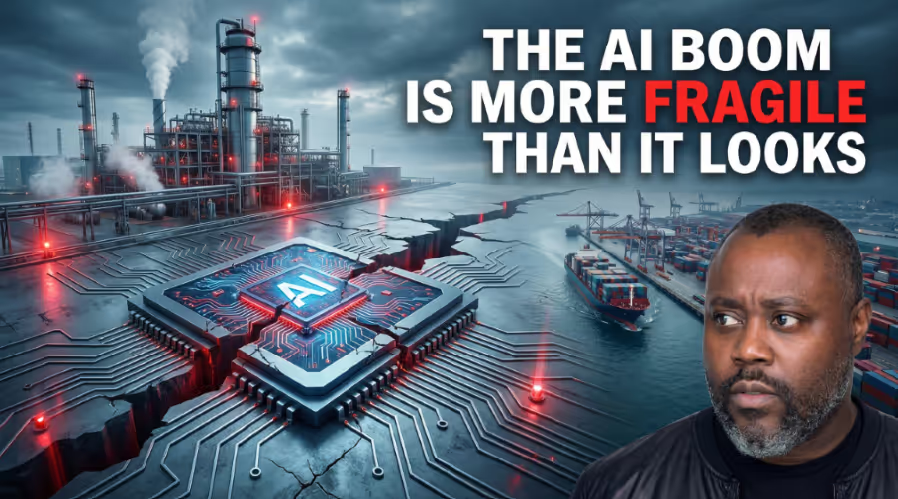
But the physical stack underneath all of it is more fragile than the public narrative suggests.
That means the winners over the next few years may not just be the companies with the best models or biggest marketing budgets. They may be the ones with the strongest procurement discipline, the best infrastructure partnerships, the clearest supply visibility, and the most grounded assumptions about cost and deployment risk.
That is a very different lens than the one dominating most AI conversations.
It is also a more useful one for business leaders.
What Smart Leaders Should Do Now
If you are planning major hardware purchases, stop assuming later will be easier.
If you are building an AI roadmap, stress test it against higher compute costs and slower infrastructure expansion.
If you are depending on third-party AI platforms, understand that their economics are tied to infrastructure you do not control.
If you are in IT, procurement, or operations, treat AI capacity as a strategic variable, not an unlimited utility.
And if you are a business leader trying to separate signal from noise, start paying more attention to the people doing the work beneath the headlines. Certification, implementation, workflow design, code integration, and infrastructure research all matter because they expose where real-world AI differs from conference-stage AI.
That gap is where the real opportunities and risks live.
Final Word
My work through Anthropic’s official Claude, Co-Work, and Claude-Code certification tracks has only made one thing clearer:
The future of AI will not be decided by software excitement alone.
It will be decided by whether the industrial, energy, and semiconductor foundations beneath that excitement can support the scale everyone is promising.
That is the dangerous blind spot.
And it is the one business leaders need to understand now, before tighter supply, higher costs, and slower timelines force the market to get honest all at once.
This is not about being bearish on AI.
It is about being serious about AI.
And serious operators do not just study the interface. They study the infrastructure.