There is a dangerous myth floating around the business world right now.
The myth says AI is making people less valuable.
That is not quite true.
AI is making unclear value less acceptable.
That is a very different problem.
For years, workers, consultants, creators, developers, marketers, and even executives have been able to rely on familiar signals. A resume. A job title. A degree. A portfolio. A list of projects. A few impressive logos. Maybe a polished LinkedIn profile with the right buzzwords sprinkled in.
That used to be enough to suggest competence.
Not anymore.
We have entered a new era where producing something is easier than proving you understood what you produced.
That is the real shift.
AI can help almost anyone generate code, copy, designs, reports, strategies, images, campaigns, websites, apps, workflows, and business plans. That is powerful. It is also dangerous, because when everyone can generate more output, output itself becomes a weaker signal.
The business question is no longer, “Can you make something?”
The better question is, “Can you explain what you made, why it matters, what tradeoffs you made, what could break, and how it creates value?”
That is where the human advantage still lives.
And business owners need to understand this quickly, because the same problem affecting tech workers is coming for every industry.
The Old Proof System Is Breaking
For a long time, effort was visible.
If someone built a product, wrote code, designed a campaign, produced a video, or created a business system, the work itself carried a signal. It usually took time, skill, training, and persistence.
Production was hard.
Because production was hard, it acted like evidence.
If you built the thing, people assumed you probably knew what you were doing.
AI breaks that chain.
Now someone can generate a website in an afternoon. They can create a campaign plan in ten minutes. They can produce a product mockup before lunch. They can build an app prototype without understanding the architecture underneath it.
That does not mean the work is worthless.
It means the work alone is no longer enough proof.
This is where a lot of business leaders are getting confused. They see more output and assume they are seeing more value. Sometimes they are. Sometimes they are just seeing more digital confetti.
More content does not automatically mean better marketing.
More code does not automatically mean better software.
More automation does not automatically mean better operations.
More AI usage does not automatically mean a smarter business.
The winners will not be the people who simply generate the most. The winners will be the people who can generate, inspect, explain, refine, and defend their decisions.
That is the difference between an AI operator and an AI-dependent button pusher.
The New Scarcity Is Comprehension
The most valuable skill in the AI era may not be prompting.
It may be comprehension.
Can you understand what the AI gave you?
Can you identify where it is wrong?
Can you explain why one option is better than another?
Can you see the hidden risk inside something that looks impressive on the surface?
This matters because AI makes it easy to skip the learning process. That is the temptation. You ask for the output, you get the output, you ship the output, and you move on.
But if you do that over and over again, you are not becoming more capable.
You are becoming more dependent.
That is a bad trade.
Business owners should be especially careful here. AI tools are incredible leverage, but leverage cuts both ways. If you use AI to accelerate your judgment, you get stronger. If you use AI to replace your judgment, you get fragile.
There is a difference between using AI as a power tool and using AI as a blindfold.
The first one multiplies your ability.
The second one hides your ignorance until the bill comes due.
Why Explanation Is Becoming a Business Asset
In the old world, the deliverable was the product.
In the AI world, the explanation needs to travel with the product.
That means every meaningful piece of AI-assisted work should include a clear explanation of four things.
What is this?
Why was it built this way?
What could break?
What was learned?
That may sound simple, but it is not. Most people cannot answer those questions clearly because they never slowed down long enough to think through the work.
This is why explanation is becoming its own class of business asset.
A marketing campaign without explanation is just content.
A workflow without explanation is just automation.
A website without explanation is just pixels.
A strategy without explanation is just a document.
But when the person behind the work can explain the thinking, the assumptions, the tradeoffs, the risks, and the next steps, suddenly you can see the human value.
That is what clients pay for.
That is what employers need.
That is what teams trust.
AI can generate the draft. It can generate the mockup. It can generate the first version. But the human still has to own the judgment.
And judgment becomes visible through explanation.
Credentials Are Losing Power
Credentials are not disappearing, but they are losing their monopoly.
Degrees still matter in some spaces. Experience still matters. Job titles still matter. But they are not enough by themselves.
Why?
Because AI has compressed the distance between idea and execution.
A person can now produce meaningful work faster than traditional career systems can measure it. The old career model says, “Show me where you worked for two years.” The new reality says, “Show me what you built, what value it created, and whether you understand it.”
That is a major shift.
For business owners, this changes hiring.
For freelancers, this changes positioning.
For marketers, this changes authority.
For employees, this changes career survival.
The resume is becoming less persuasive unless it is connected to visible proof. Not just proof that you made something, but proof that you can think through what you made.
That is the new professional currency.
Work in Public, But Do It Strategically
There is another uncomfortable truth here.
Private talent is becoming harder to discover.
If nobody can see your work, nobody can evaluate your growth.
That does not mean every business owner needs to turn into a full-time influencer. It does not mean every employee needs to post every project online. It does not mean you should share confidential client work or company secrets.
It means you need a visible trail of thinking.
Share what you are learning.
Share how you solved a problem.
Share before and after examples.
Share your decision-making process.
Share the business lesson behind the tool.
Share the mistake you caught before it became expensive.
This is not vanity. This is market visibility.
In a noisy AI world, people trust the person who can explain the work, not just display the work.
That is why business owners should start treating public explanation as part of their marketing engine. The market does not just want to know what you sell. It wants to know how you think.
That is where trust is built.
The “Slop Factory” Problem
Here is the blunt truth.
A lot of people are about to become AI slop factories.
They will generate endless content, endless graphics, endless funnels, endless apps, endless posts, endless reports, and endless noise.
At first, it will look productive.
Then customers will stop paying attention.
Why?
Because the market can smell shallow work.
People may not know the technical details, but they can tell when something feels generic. They can tell when the message has no point of view. They can tell when the offer is hollow. They can tell when the business is using AI to avoid thinking instead of using AI to think better.
That is the trap.
AI should not make your business sound like everyone else.
AI should help you express your unique judgment faster, clearer, and more consistently.
The goal is not to create more stuff.
The goal is to create more meaningful proof.
What Business Owners Should Do Now
Here is the practical play.
First, stop treating AI output as the final product. Treat it as raw material.
Second, build a habit of explanation around every important AI-assisted deliverable. Before you ship it, ask:
What is this supposed to accomplish?
Why did we choose this direction?
What assumptions are baked into it?
Where could this fail?
What did we reject?
What did we learn?
Third, create a visible proof system. This could be a case study library, a project board, a content series, a client results archive, a behind-the-scenes newsletter, or a public learning log.
Fourth, train your team to value comprehension over speed. Speed matters, but speed without understanding creates risk.
Fifth, make human judgment your brand advantage.
That is the move.
The businesses that win with AI will not be the ones that automate everything blindly. They will be the ones that combine AI speed with human clarity.
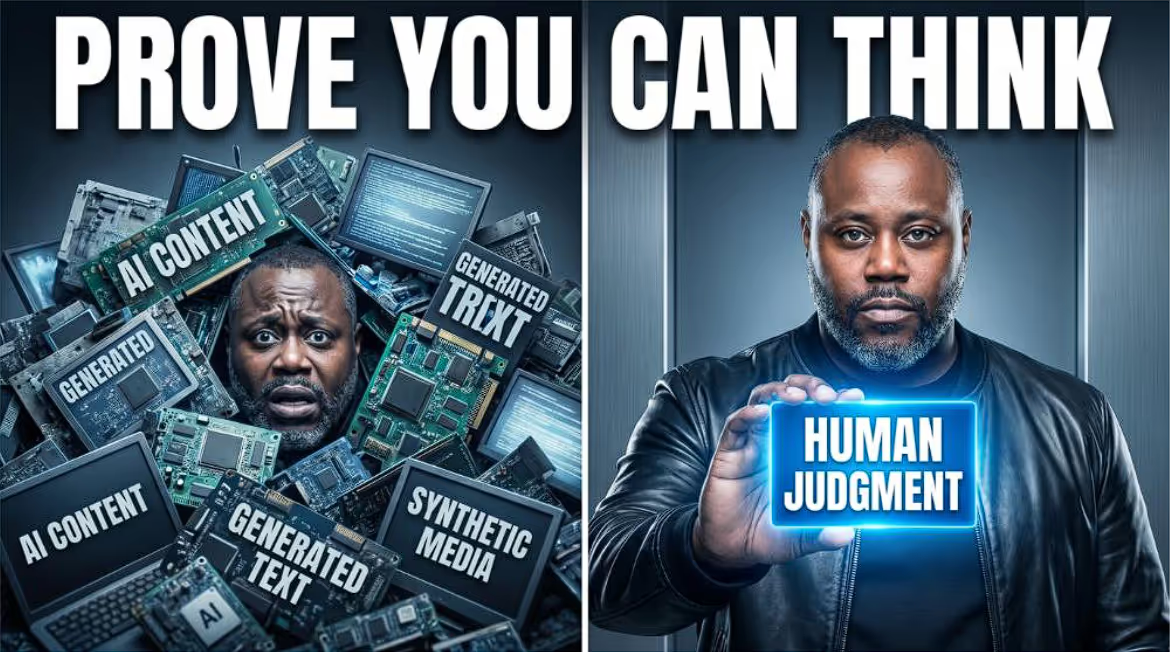
The Real Career Skill Is Proving You Can Still Think
The AI era is not asking whether you can produce.
It is asking whether you can prove you can think.
That applies to employees.
It applies to consultants.
It applies to agencies.
It applies to business owners.
It applies to every professional who wants to stay relevant.
Because when generation becomes cheap, discernment becomes expensive.
When output becomes abundant, explanation becomes scarce.
When tools become powerful, judgment becomes the differentiator.
So do not just show people what you made.
Show them how you think.
Show them what you understood.
Show them where you made the hard call.
Show them what you caught that AI missed.
Show them why your work matters.
That is how you prove your value now.
And that is how you stay valuable in a world where everyone has access to the same magic machine.