
February 10, 2026
Celebrity Cringe Is the New Recession Indicator.
Every year, the Super Bowl positions itself as the Olympics of advertising. Big budgets. Big ideas. Bigger celebrities. Historically, these commercials were cultural flexes. This year, they felt like humiliation rituals with lighting budgets.
Monster cringe. Golden cringe.
Not accidental cringe. Not edgy humor that missed the mark. This was prestige erosion in real time. A parade of A-list celebrities doing things that would have been unthinkable a decade ago. Not because the ideas were brave. Because the checks cleared.
That’s not a creative trend. That’s a macroeconomic one.
When icons willingly flatten themselves into punchlines, something upstream is broken. And this year’s Super Bowl commercials felt less like brand storytelling and more like a liquidation sale of cultural capital.
Let’s call it what it is. A recession indicator wearing a celebrity wig.
When Prestige Becomes Disposable
Once upon a time, the joke was that an A-list actor doing a fast-food commercial meant their career was in trouble. Think Jack and Jill and the infamous Dunkaccino gag. The humor worked because it felt impossible.
Fast forward to now. Impossible became standard operating procedure.
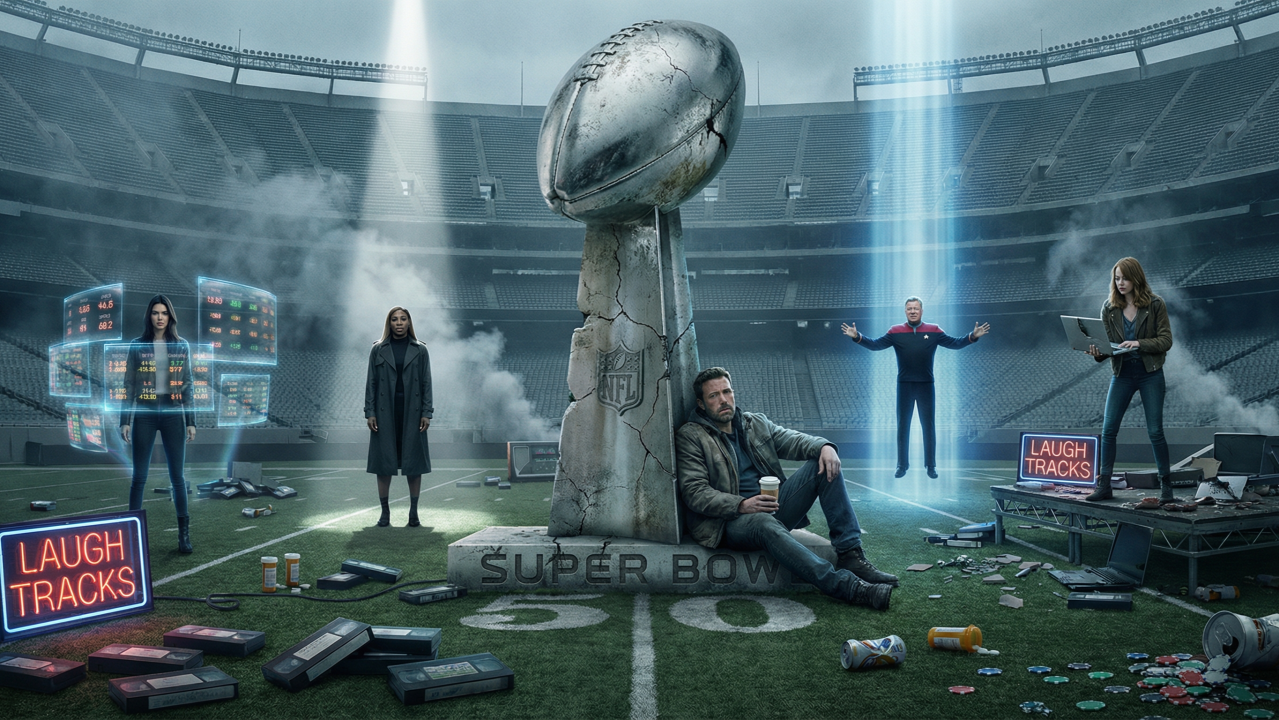
We watched William Shatner build an entire commercial around the fact that his last name sounds like bodily waste. We watched Serena Williams promote a weight-loss drug despite a career built on peak physical excellence. We watched Kendall Jenner turn her dating history into a gambling joke.
These weren’t accidents. These were negotiated outcomes.
When the richest brands in the world stop protecting the dignity of their talent, it’s because dignity is no longer the asset being optimized. Attention is. And attention is cheap when fear is expensive.
Nostalgia Isn’t Strategy. It’s Insurance.
One of the loudest themes this year was nostalgia-as-a-crutch.
Ben Affleck, Jennifer Aniston, Matt LeBlanc, and Jason Alexander digitally de-aged themselves for a fake ’90s sitcom Dunkin’ parody. Scarlett Johansson jet-skied into a Ritz Crackers bit. Jeff Goldblum reprised his iconic cadence for Xfinity.
None of this was about innovation.
It was about risk reduction.
Nostalgia works because it’s pre-approved by memory. You’re not selling a product. You’re borrowing emotional equity that was built decades ago and hoping it still converts.
That’s not confidence. That’s hedging.
Celebrity Density Is a Red Flag, Not a Flex
Here’s the stat most people missed.
In 2018, roughly 30 percent of Super Bowl commercials featured celebrities. Last year, that number was closer to 70 percent.
That’s not because creativity exploded. It’s because uncertainty did.
When a single 30-second slot costs north of $8 million before production, brands panic. And panic leads to the safest possible decision: recognizable faces.
That’s how you end up with Post Malone, Shane Gillis, and Peyton Manning appearing in a Bud Light ad where none of them actually matter to the concept.
Familiarity replaced function.
That’s expensive filler, not strategy.
When the Product Disappears, the Brand Loses
Some of the most costly ads this year forgot the one unforgivable rule of advertising.
Sell the product.
The Instacart spot directed by Spike Jonze looked beautiful. It starred Ben Stiller and Benson Boone. It felt like premium sketch comedy.
It also barely explained why Instacart matters.
Same problem with State Farm. Yes, Danny McBride and Keegan-Michael Key can sing. Yes, “Living on a Prayer” is evergreen. No, that does not automatically translate into brand clarity.
If your audience remembers the joke but forgets the value proposition, you didn’t advertise. You entertained on borrowed time.
When It Works, It’s Because the Celebrity Fits the Product
Not everything missed.
The Squarespace ad starring Emma Stone, directed by Yorgos Lanthimos, worked because it respected intelligence. Clear pain point. Clear solution. Clear takeaway.
Same with Pepsi. Reigniting the cola war by flipping the script on the iconic polar bear was smart because it directly reinforced product preference. Add Taika Waititi as a therapist and the absurdity served the idea, not the other way around.
Even the Pringles ad with Sabrina Carpenter worked because it aligned with her existing persona. The brand didn’t flatten her. It amplified what her audience already understands.
That’s the difference between leverage and liquidation.
The Real Takeaway for Business Owners
This isn’t about celebrities behaving badly. It’s about incentives shifting.
Big brands are playing defense. Celebrities are monetizing relevance before it expires. And creativity is being asked to do more with less courage.
If you’re a business owner or marketer, here’s the lesson.
Attention bought with familiarity is fragile. Trust built through clarity compounds.
You don’t need a famous face. You need a clear reason to exist. When money tightens, the brands that survive aren’t the ones that shout louder. They’re the ones that explain better.
This year’s Super Bowl ads didn’t just sell products. They accidentally exposed the economic mood.
And it wasn’t optimistic.