March 25, 2026
Why the next phase of artificial intelligence may be less open, less equal, and a lot more political
Three dates. Three announcements. One pattern most people missed.
January 14. February 12. February 19.
Look at them separately and you get another week in AI news. Look at them together and you get something much bigger: a warning that the future of artificial intelligence may not be open to the public for much longer.
That is the real story here.
Not just model theft. Not just export controls. Not just another US-versus-China headline.
The real story is this: the biggest AI companies may now have both the motivation and the justification to pull frontier capability farther behind closed doors. And if that happens, business owners, marketers, local retailers, and everyday operators will be the ones left working with leftovers.
That is the part that should get your attention.
The Timeline Is Too Convenient to Ignore
Start with January 14.
The US government signals a potential shift in semiconductor policy and opens the door to broader conversations around advanced chip flows and AI competition. That matters because compute is not some side issue in AI. Compute is power. Compute is speed. Compute is dominance.
Then February 12 arrives.
Suddenly, major US AI labs begin highlighting growing concerns around model extraction and distillation attacks. The message is clear: foreign competitors may be learning from American frontier systems without paying the cost of building them.
One week later, on February 19, another major AI company publishes a more detailed warning, describing industrial-scale attempts to extract capabilities through large volumes of coordinated interactions.
Now ask the obvious question.
Is that timing random?
Maybe. But serious people should stop pretending that is the only possibility.
Because there are two plausible readings of this sequence, and both matter.
The first is that this is a genuine national security alarm. The second is that this is highly effective strategic lobbying wrapped in the language of national security.
And the uncomfortable truth is that both can be true at the same time.
What Distillation Really Means
Most people hear the word “distillation” and assume this is some niche engineering trick that only matters inside research labs.
Wrong.
Distillation is one of the most important mechanics in modern AI development.
At its simplest, a more capable model teaches a smaller model through outputs, examples, reasoning traces, and response patterns. That smaller model then becomes cheaper, faster, and easier to deploy. This is standard practice inside the industry. Labs do it all the time to optimize performance and cost.
The problem is not distillation itself.
The problem is unauthorized distillation.
If one company spends billions building advanced reasoning, tool use, coding ability, or domain intelligence, and a competitor can infer those capabilities through large-scale querying, then the second company may collapse years of research into a fraction of the time and expense.
That is not a small issue. That is an economic earthquake.
And from a business standpoint, it changes everything.
Because once public access becomes the attack surface, every AI lab faces the same hard choice: keep the doors open and risk capability leakage, or limit access and protect the moat.
You already know which way corporations lean when billions are on the line.
The Hypocrisy Problem Is Real
Now let’s deal with the part many executives want to skip.
The public was never going to accept this narrative cleanly.
Why? Because the same companies warning about intellectual property theft built their systems on oceans of public internet data, books, articles, forums, and copyrighted material. Whether legal, fair use, tolerated, or contested, that history is not forgotten.
So when these labs claim outrage that someone else may be learning from their outputs, a lot of people hear this:
“You were fine when the training pipeline benefited you. Now you want protection when someone does a version of it back.”
That is why the hypocrisy critique landed so hard.
And frankly, it is not a ridiculous critique.
But business leaders need to avoid the lazy conclusion here. Hypocrisy does not automatically make the underlying threat fake. A flawed messenger can still be describing a real problem.
That is where grown-up analysis matters.
You do not have to excuse how the first generation of frontier models was trained in order to see that unauthorized capability extraction from frontier systems creates serious incentives, serious security concerns, and serious policy consequences.
Why This Is Bigger Than Corporate Competition
A lot of coverage frames this as Silicon Valley drama.
That misses the real stakes.
If advanced capabilities can be extracted faster than safety measures can be transferred, then the downstream risk is not just that one company loses a market lead. The downstream risk is that dangerous capabilities spread without corresponding controls.
That matters more as models become stronger.
Today’s systems are useful, impressive, and in some cases operationally transformative. Tomorrow’s systems may be able to materially accelerate cyber operations, disinformation, vulnerability discovery, biological research, or autonomous workflows at levels that governments will not treat casually.
Once policymakers believe that frontier models can enable real-world harm at scale, public access stops being a product question. It becomes a national security question.
And once that happens, openness loses.
Not because open access was a bad dream. Because fear is a stronger political force than idealism.
The Real Endgame: A Two-Tier AI Economy
Here is the part I think business owners need to understand right now.
This is not just a debate about China. It is not just a fight over theft. It is not just about export controls.
It is the setup for a two-tier AI economy.
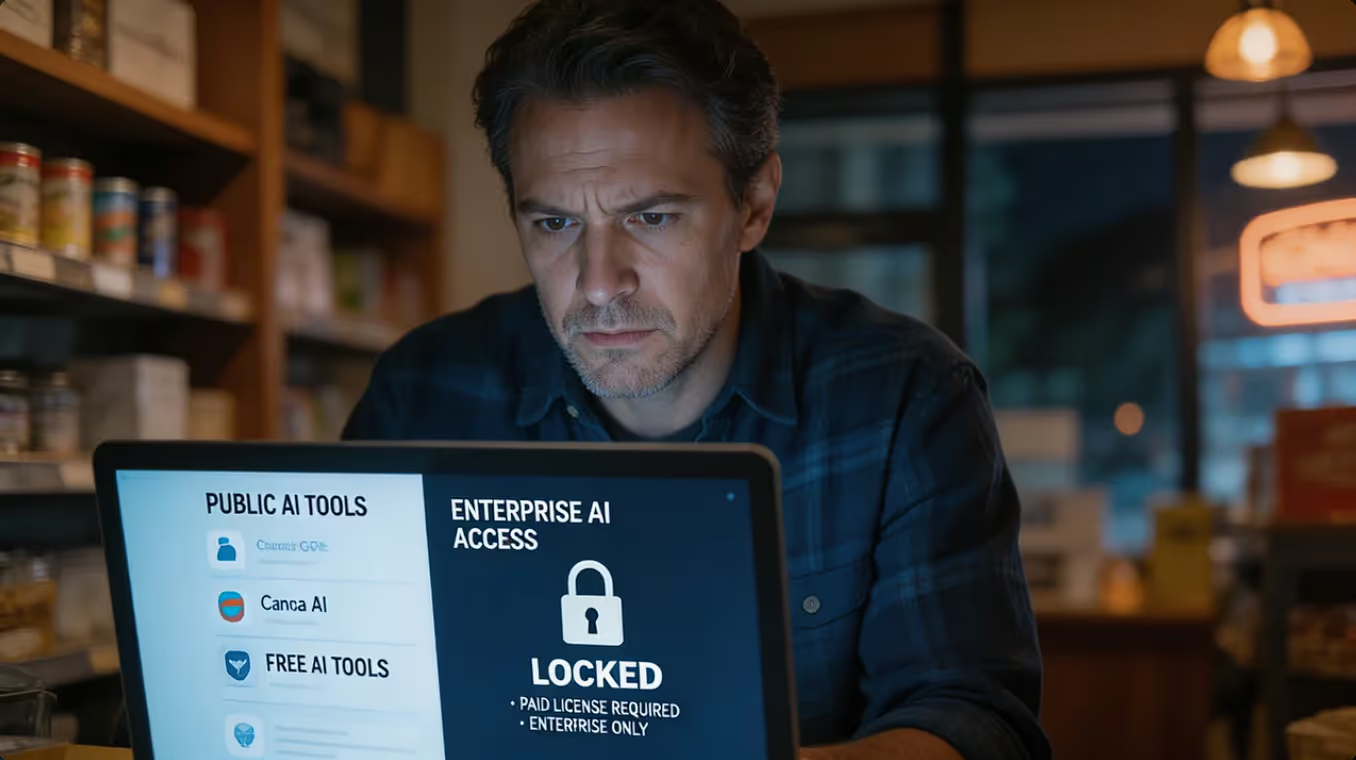
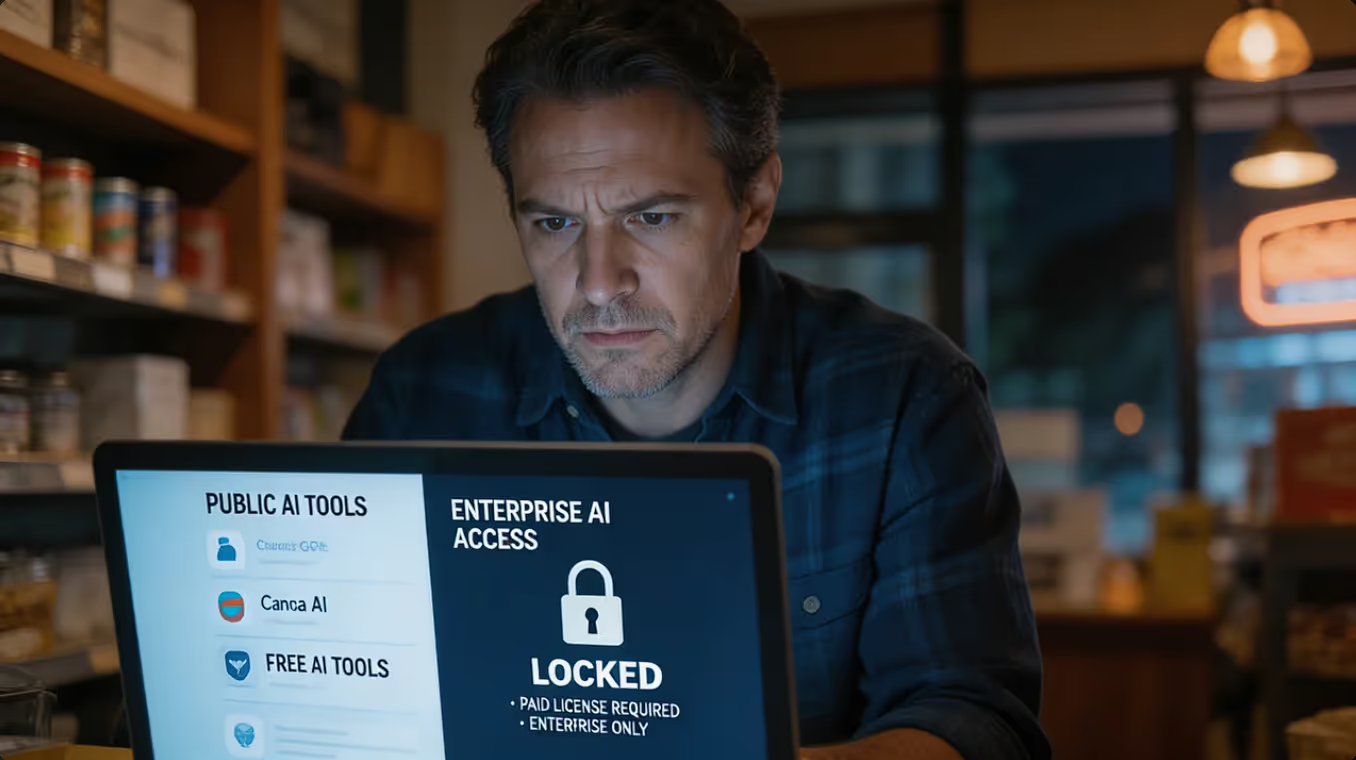
Tier one will be restricted frontier access. Think governments, defense partners, major enterprises, elite research institutions, and approved strategic players. They will get the most capable systems, the newest models, the deepest integrations, and the best performance.
Tier two will be everyone else.
That includes plenty of small businesses, agencies, independent creators, consultants, local retailers, and mid-market companies that assume AI access will keep improving for the general public forever.
That assumption is getting weaker by the month.
The public may still get excellent tools. Let’s be clear about that. But excellent is not the same as frontier. And if the gap between internal capability and public capability widens, then a lot of companies will be competing with the illusion of parity while larger players operate with a very different class of intelligence.
That is not science fiction. That is how strategic technologies usually mature.
The first phase feels open. The second phase gets controlled.
What This Means for Business Owners Right Now
This is where most commentary falls apart. It gets dramatic, philosophical, and abstract.
Let’s make it practical.
If the AI frontier is closing, then timing matters.
The companies that build real internal capability now will be less vulnerable later. The companies that wait for “better tools next year” may discover that better tools exist, but not for them.
That changes how you should think about adoption.
Do not treat today’s public AI stack as a toy. Treat it as a training ground.
Use the current window to build operational habits. Create workflows. Document prompts. Train staff. Integrate AI into content production, customer support, research, sales enablement, local SEO, reporting, and creative iteration. Build muscle while access is still broad and relatively cheap.
Because once the market shifts toward controlled access, those who already know how to generate business outcomes from AI will have leverage. Those who are still experimenting casually will be behind.
And let’s make this even more specific.
If you run a local business, AI can already compress the cost of marketing execution, customer communication, inventory messaging, offer testing, and content creation.
If you run an agency, AI can increase output per employee, accelerate campaign development, and reduce turnaround time.
If you run an e-commerce brand, AI can tighten merchandising, optimize product copy, improve email testing, and scale creative ideation.
If you lead a service business, AI can sharpen proposals, automate follow-up, improve knowledge retrieval, and standardize internal communication.
The point is not to admire the tools.
The point is to operationalize them before access becomes more stratified.
Watch the Policy, Not Just the Product Launches
Most people follow AI like consumers.
They watch demos. They compare features. They talk about which chatbot sounds smarter this week.
Meanwhile, the real power is being shaped elsewhere.
Policy. Export controls. compute access. regulatory framing. national security language. enterprise partnerships.
That is where the future of AI access will be decided.
The next six to twelve months matter because they will influence whether public AI remains a rapidly advancing utility or starts to plateau while more powerful capability moves into private channels.
That means business leaders should stop treating AI policy as someone else’s problem.
If policy shifts determine who gets compute, who gets access, who gets partnership status, and which models stay behind closed doors, then policy is business strategy.
Ignore it at your own risk.
The Contrarian Take Nobody Wants to Say Out Loud
Here it is.
The open frontier may not survive success.
Not because the technology failed. Because it worked too well.
Once AI becomes strategically valuable enough, nobody with power wants universal access to the best version of it. Not governments. Not corporations. Not defense agencies. Not platform owners. Not shareholders.
Every one of them has an incentive to say the same thing in slightly different language:
“This is too important to leave fully open.”
And that is how major shifts happen. Not all at once. Not with a giant public announcement. But gradually, through safety arguments, security incidents, policy adjustments, enterprise packages, compliance requirements, and premium access tiers.
One day you wake up and realize the real frontier never disappeared.
It just stopped being public.
What You Should Do Next
First, build now.
Do not wait for perfect clarity. Start embedding AI into the way your business operates today.
Second, diversify your dependence.
Do not build your entire future on one model, one interface, or one provider. Develop cross-platform fluency now.
Third, prioritize proprietary advantage.
The businesses that win with AI will not just use public tools. They will combine them with private data, internal processes, customer insight, and strong execution.
Fourth, pay attention to access.
Who gets early features? Who gets enterprise deals? Who gets deeper integrations? Those signals matter more than social media hype.
Fifth, think strategically, not cosmetically.
Using AI to write one caption faster is not transformation. Using AI to redesign how your business creates, sells, serves, and scales is transformation.
That is the game.
The Door Is Still Open. For Now.
Three dates. Three announcements. One pattern.
Maybe this was a real alarm. Maybe it was strategic lobbying. Most likely, it was both.
But the result is the same.
The case for limiting frontier AI access is getting stronger. The companies with the most powerful systems now have more reason than ever to keep their best capabilities protected, gated, and selectively deployed.
That should not make you panic.
It should make you move.
Because the window that exists today may not remain this open. And in business, the companies that prepare before the shift are the ones still standing when everyone else is asking what happened.
The AI cold war is not a future headline.
It is a present-tense business reality.
The only real question is whether your company is building on the public side of history or positioning itself for the private side of power.