March 18, 2026
There are moments in business when a trend stops being optional and starts becoming structural.
This is one of those moments.
In 2026, automation is no longer a shiny object for tech founders, enterprise teams, or people who love playing with software. It has crossed into the part of the market that actually matters: real businesses trying to protect margins, respond faster, follow up better, and scale without hiring chaos. n8n alone now sits at roughly 179,000 GitHub stars, and the company said in March 2025 that it was already used by more than 200,000 people worldwide. Meanwhile, Hostinger is actively marketing one-click n8n VPS hosting, which tells you something important. This category is no longer fringe. It is productized infrastructure.
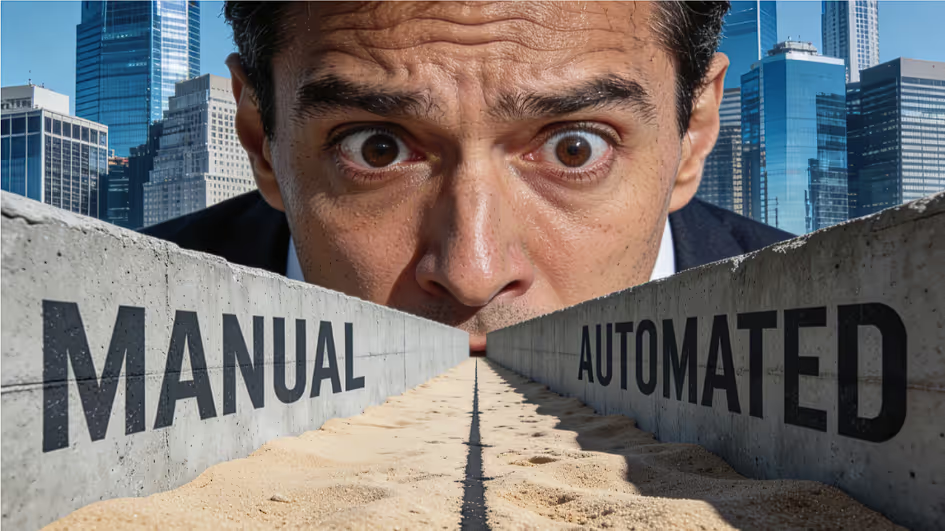
That is the line in the sand.
On one side are businesses building automated systems into the way they operate. On the other side are businesses still depending on people to remember, chase, copy, update, follow up, and manually piece together what happened last week.
Right now, that still looks like a performance gap.
Soon, it is going to look like a permanent advantage.
I have watched this pattern before. Companies that delayed websites lost years. Companies that treated social media like a fad handed attention to competitors who never gave it back. Automation is the next version of that story, except the adoption curve is moving faster because the tooling is easier, the cost is lower, and the pain of staying manual is now measurable. The workflow automation market is projected to reach roughly $77.8 billion by 2030, which means this is not a side category anymore. It is becoming core business infrastructure.
The Real Cost of Staying Manual
Most owners do not think they are choosing manual work. They think they are just being responsible.
They are checking the inbox themselves. Updating the CRM themselves. Following up when they can. Pulling reports on Monday when they find the time. Sending invoices after hours. Digging through spreadsheets before a meeting.
That does not feel like a strategic decision in the moment.
But stacked over a year, it becomes one.
A survey highlighted by Time etc found entrepreneurs spend about 36% of their work week on administrative tasks such as invoicing, data entry, and ordering supplies. Based on the same report, the average work week was 45.5 hours. That works out to roughly 16.4 hours every week on admin-heavy work. Over a year, that is about 850 hours. At even a conservative founder value of $100 per hour, that is roughly $85,000 worth of leadership time redirected into mechanical tasks.
That number matters, but the money is not the only issue.
The bigger problem is what manual businesses become.
They become slower to respond.
They become inconsistent in follow-up.
They become dependent on memory instead of systems.
They become fragile.
And fragile businesses always look “busy” right before they start losing ground.
Automation Has Quietly Gone Mainstream
Here is the part many owners still have not processed.
Automation is no longer reserved for large teams with internal developers. Small and midsize companies are using it precisely because it helps them compete above their weight class. Zapier’s SMB automation research found that 88% of SMBs said automation allows them to compete with larger companies by helping them move faster, follow up more quickly, reduce busywork, cut errors, and improve customer service.
That is the headline most people missed.
Automation is not just an efficiency tool. It is a force multiplier for smaller businesses.
It lets a lean company behave with the responsiveness, consistency, and operational discipline of a much bigger one. That is why the old conversation about whether automation is “worth it” is already stale. The better question is this:
How long can a manual business compete against a business whose systems never forget, never stall, and never need to be reminded?
What Winning Businesses Get Right
When you study businesses that make automation work, the pattern is not random.
They do three things right.
1. They start with the biggest drain, not the flashiest idea
Most owners want to automate something sexy. AI content. Voice bots. some futuristic workflow they can show off on LinkedIn.
That is the wrong first move.
The best automation projects begin with the ugliest operational leak in the business. Lead follow-up. Invoice chasing. Intake triage. CRM cleanup. Reporting. Internal handoffs.
Why?
Because that is where the hours are.
And hours are not just time. Hours are opportunity cost. Every hour an owner or high-value employee spends doing repeatable mechanical work is an hour not spent selling, strategizing, building partnerships, improving retention, or fixing a genuine bottleneck.
2. They treat automation as leverage, not replacement
Weak operators use automation language like a staffing strategy.
Strong operators use it like a leverage strategy.
That distinction matters.
If your entire automation mindset is “How do I replace people?” you will build brittle systems and create internal resistance. But if your mindset is “How do I free people to do the work only humans should be doing?” the quality of what you build changes immediately.
Machines are excellent at persistence, routing, formatting, triggering, summarizing, and organizing.
Humans are still better at judgment, trust, negotiation, creativity, and nuance.
The companies that win combine both.
3. They build systems that compound
A one-off automation can save an hour.
A connected automation system can change the economics of the business.
When lead capture feeds the CRM, the CRM triggers outreach, outreach activity updates the sales pipeline, the pipeline triggers invoicing, and the entire thing rolls into a weekly executive briefing, you are no longer saving isolated minutes.
You are building an operating system.
That is the real goal.
Not random workflows.
Not disconnected hacks.
A system.
The Three Automations I’d Build First in 2026
If I were starting from zero today, these are the first three I would build.

1. The Lead Machine
Not a lead list. A lead machine.
This system should wake up on a schedule, pull fresh prospect data from public sources, enrich the records, create usable context, and push qualified leads into your CRM or outreach queue.
The value is not just data collection.
The value is that your business stops depending on your mood, your memory, or your spare time to create pipeline.
Every morning, the machine should hand you a cleaner list of opportunities than most businesses create in a week manually.
2. The Follow-Up Engine
This is where revenue leaks in most small businesses.
Owners think they are “pretty good” at follow-up. In reality, most are situationally good. When the week gets busy, follow-up slips. When follow-up slips, leads cool off. When leads cool off, the business tells itself demand is soft.
No. The system is soft.
A proper follow-up engine should trigger the second a lead enters the pipeline. It should send timed touches, stop when a reply comes in, notify the right person, and surface the warmest opportunities for human attention.
That is not impersonal. That is disciplined.
The machine handles consistency. The human handles the relationship.
3. The Weekly Intelligence Briefing
This is the most underrated automation of the three.
Most businesses have dashboards they never open, reports nobody reads, and data scattered across tools that never gets synthesized into a decision.
A weekly intelligence workflow should pull the key metrics from revenue, lead flow, conversion, campaign activity, support issues, and customer feedback, then turn all of it into one executive briefing.
What is up.
What is down.
What changed.
What deserves attention this week.
That is the difference between reacting to your business and actually steering it.
Why This Matters More Than the Software
Yes, tools matter. Yes, stack choices matter. Yes, n8n’s scale, momentum, and ecosystem growth matter. And yes, self-hosting options have become cheap enough to remove a huge amount of friction, with Hostinger currently advertising n8n VPS plans starting around $6.49 per month and a more popular tier at $8.99 per month on a 24-month term.
But the real issue is not software.
It is identity.
Too many owners are still operating as the system instead of building the system.
They are the reminder.
They are the follow-up.
They are the reporting layer.
They are the handoff.
They are the safety net.
That works for a while. Then growth punishes it.
Because once the business depends on you to keep every gear moving, freedom disappears. Strategic thinking disappears. Scale disappears. You do not own a business at that point. You own a job with overhead.
Automation is the transfer of the mechanical from your brain to a system.
And once that transfer happens, something important returns.
Judgment.
Focus.
Creative energy.
Presence.
The ability to lead instead of chase.
That is why automation in 2026 is not just a productivity conversation. It is a business model conversation. The companies building these systems now are not merely saving time. They are building a structural advantage that compounds month after month.
Today it looks like speed.
Tomorrow it looks like dominance.
The line is already there.
The only question is which side of it your business is standing on.