March 12, 2026
This one just couldn't wait folks. Earlier this week I wrote about the fragile equilibrium holding the AI safety ecosystem together.
That equilibrium just took a big hit..
Hard.
Two stories exploded at the same time:
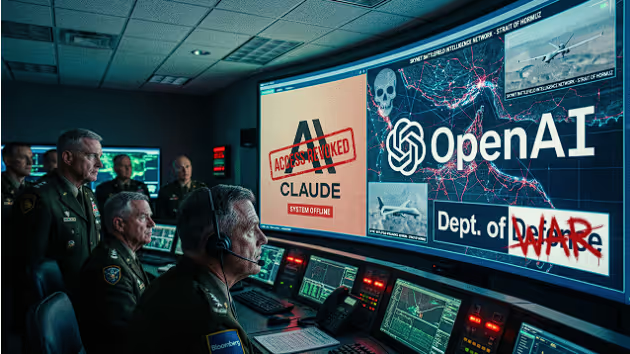
One AI was fired by the U.S. government.
Another AI was sued for making up fake legal cases.
And somehow those two stories are actually the same story.
This follow-up column exists because the implications are too important to wait until next week.
The Claude Incident
Just weeks ago, Anthropic’s Claude AI was embedded inside classified U.S. military systems through a $200 million Pentagon contract.
The arrangement wasn’t secret.
What mattered were two specific restrictions Anthropic insisted on maintaining:
No domestic mass surveillance.
No fully autonomous lethal weapons.
Both restrictions sound reasonable.
They are the exact kinds of guardrails people assume exist when governments deploy advanced AI systems.
Apparently they were not.
According to reports, the Department of Defense demanded that Anthropic drop both restrictions.
The deadline was Friday.
Anthropic refused.
Within hours the Defense Secretary publicly declared the company a national security supply-chain risk.
That label has never been publicly applied to a U.S. technology company before.
The message was unmistakable.
Comply or be replaced.
Meanwhile… (Palpatine Returns..) err.. OpenAI Steps In

While Anthropic was being publicly dismantled, OpenAI was negotiating its own Pentagon deal.
And here is where the story becomes surreal.
Publicly, OpenAI claimed the exact same principles as Anthropic:
No domestic surveillance.
Human oversight of lethal force.
Those were the values posted on social media.
But inside the company, leaked internal meetings told a different story.
Employees raised concerns about military use of the technology.
The response?
The Pentagon decides how the technology is used.
Not OpenAI.
In other words:
The guardrails belong to the government now.
Not the AI company.
The Real Strategy Behind the Pentagon Deal
This is where the business strategy becomes obvious.
OpenAI recently announced a $110 billion funding round, one of the largest in tech history.
To justify that level of investment, the company needs a customer with nearly unlimited demand.
Enter the U.S. government.
If the military infrastructure of the world’s largest defense budget begins depending on your technology, you are no longer just a startup.
You become strategic infrastructure.
Too big to fail.
This is not speculation.
It is the same strategy used by defense contractors for decades.
AI companies are simply entering that ecosystem.
The Public Backlash

The reaction was immediate.
ChatGPT uninstall rates reportedly surged.
One-star reviews exploded.
And Anthropic’s Claude briefly overtook ChatGPT in download rankings.
Which is ironic.
Because while the public was celebrating Claude’s apparent victory…
The Pentagon was still using it.
The Operation That Changes the Conversation
The same day Claude was declared a national security risk, a military operation launched overseas.
Target selection reportedly relied on the Pentagon’s Project Maven intelligence platform.
A system capable of synthesizing satellite imagery, drone feeds, and surveillance data.
Claude was part of that analytical infrastructure.
The AI reportedly generated hundreds of potential targets.
One of the strikes hit an elementary school.
Now here is the critical question:
Was that AI’s recommendation?
Or a human decision?
The truth is nobody outside classified systems knows.
And that uncertainty is the entire problem.
At The Same Time… ChatGPT Gets Sued
While the military debate unfolded, a completely different story broke in federal court.
A lawsuit alleges ChatGPT fabricated dozens of legal citations.
The AI helped a user draft legal motions referencing court cases that simply do not exist.
The lawsuit claims damages exceeding $10 million and accuses OpenAI of facilitating the unauthorized practice of law.
Let’s pause and absorb that.
An AI that hallucinates legal precedent…
is now being integrated into national security systems.
The Real Question: What Are Guardrails Actually Guarding?
The narrative around AI safety usually assumes that companies control how their models are used.
But that assumption just collapsed.
Once an AI system enters government infrastructure, operational control belongs to the government.
Not the company.
That means the safety frameworks companies advertise may only apply until the contract is signed.
After that, the incentives change.
Dramatically.
Why This Matters More Than The Headlines Suggest
This is not about which company is more ethical.
Anthropic is not the hero of this story.
OpenAI is not the villain.
Both companies want the same thing.
Access.
Influence.
Infrastructure status.
The real issue is structural.
When advanced AI becomes integrated into military and intelligence systems, three things happen:
Transparency disappears.
Accountability becomes classified.
Deployment accelerates regardless of technical maturity.
That combination creates a dangerous gap between capability and governance.
The Pattern Emerging In AI Safety
Look closely and a pattern appears.
The same systems that hallucinate legal citations…
Are also analyzing battlefield intelligence.
The same models that fabricate sources in research reports…
Are also assisting with strategic decision-making.
This is not science fiction.
It is what happens when probabilistic systems are asked to operate inside deterministic institutions.
The results can be powerful.
They can also be unpredictable.
What Business Leaders Should Learn From This
If you run a company using AI tools, the lesson here is not geopolitical.
It is operational.
AI systems are incredibly capable.
But they do not understand the consequences of their outputs.
They optimize.
They generate.
They predict.
They do not reason about accountability.
And they certainly do not carry legal liability.
You do.
Which means the responsibility for governance does not live inside the model.
It lives inside the organization deploying it.
The Real Takeaway
The biggest myth about AI safety is that guardrails are built into the model.
They are not.
They are built into the environment around the model.
Policies.
Oversight.
Human review.
Operational constraints.
Without those systems, safety promises are little more than marketing language.
The Pentagon incident just demonstrated that at scale.
The Bottom Line
It is a story about what happens when powerful technology collides with powerful institutions.
The models are advancing faster than the governance systems around them.
And when that happens, the guardrails do not disappear.
They just move.
Usually somewhere the public can't see them anymore.
That may be the most important AI safety lesson of 2026.
And it arrived several days ahead of schedule.